

Virginia Voters Will Soon Decide on Redistricting
Democrats have overreached, but Republicans are gaslighting voters about why we're here

Voters in the Commonwealth of Virginia are currently deciding whether or not to approve new congressional districts passed by the Virginia General Assembly. Although early voting is now happening, the votes will be counted on April 21. The new map would fundamentally change the partisan composition of the Commonwealth’s congressional delegation. The effort is part of the mid-cycle redistricting that Republicans kicked off last year with the Texas gerrymander.
In 2020, Virginia voters approved the Redistricting Commission Amendment. This took the power to redraw the Commonwealth’s congressional, state House, and state Senate district lines. The Virginia Redistricting Commission attempted to draw the lines in 2021, but failed to reach an agreement. Consistent with Section 6-A(g) of the Virginia Constitution, the Supreme Court of Virginia stepped in to create the new maps. The Supreme Court of Virginia completed this process in December 2021.
Currently, under the December 2021 maps, Virginia’s House delegation comprises six Democrats and five Republicans. The new map would most likely shift the delegation to ten Democrats and one Republican. Democrats were likely to pick up one congressional district in Virginia.1 Picking up a second district was entirely possible.2 They may still pick up those two seats if the amendment fails on April 21. One currently Democratic-held seat is considered competitive.3 Considering the political atmosphere, it’s unlikely to flip. Generally, the redistricting commission concept is a good one. The fact that three seats are competitive under the current maps is a decent outcome. Granted, I’d like to see more competitive seats,4 but I’ll take what I can get.
As one can imagine, the campaign over the proposed maps is intense. Television ads, yard signs, and billboards are everywhere. Mailers, texts, and emails are hitting mailboxes, inboxes, and phones faster than you can wonder why every message sounds like it was written by the same five consultants. On the Democratic side, the new lines are clearly an overstep, and I’m not entirely sure it won’t completely backfire on them before the next round of redistricting after the 2030 Census.
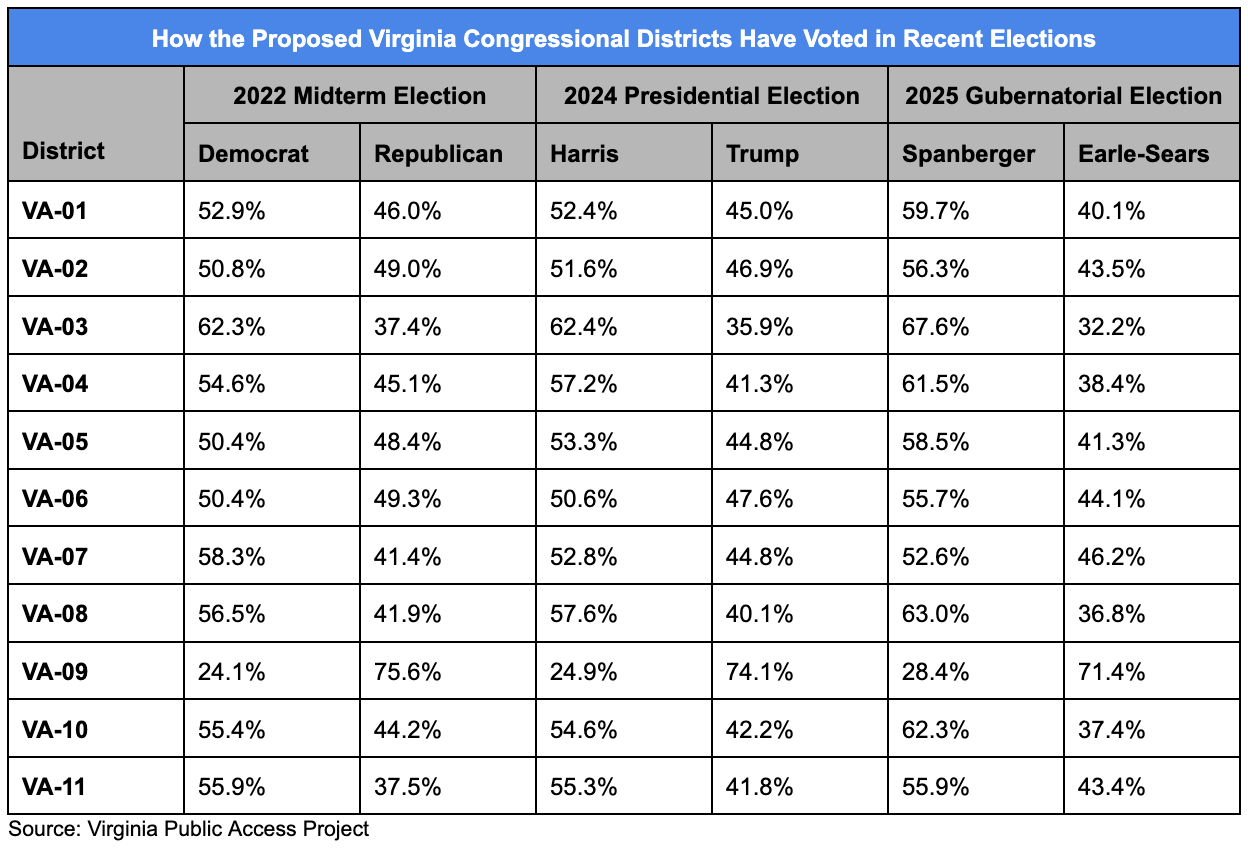
Democrats seemingly have looked at voters in the districts where they have had majorities in recent elections as committed partisans who won’t flip. Many may well be committed Democrats, but the majority of voters aren’t. There are plenty of independent voters in these districts. You also have to consider that Abigail Spanberger’s numbers are inflated because Winsome Earle-Sears was a uniquely bad candidate in a strong Democratic cycle. So, while these new districts may create a ten-to-one delegation in 2026. Will it be the same in 2028 or 2030, particularly if the hyperpartisan fever begins to break? It’s a gamble.
On the Republican side, the argument is that the proposed maps are unfair and a partisan gerrymander. They point to the likely outcome—a lopsided delegation—as evidence that the lines are being drawn to predetermine results rather than reflect actual voter distribution. The critique goes beyond the map itself. Republicans are also arguing that Democrats are effectively sidelining the bipartisan redistricting framework voters approved just a few years ago, trading a rules-based system for a moment of partisan advantage. Humorously, they also say mid-decade redistricting, absent a court order or census update, looks less like governance and more like escalation. If one party redraws lines whenever it sees an opening, the incentive structure shifts from stability to constant retaliation.
Now, the Republican arguments against this aren’t necessarily unreasonable or wrong. Most of them are compelling if you aren’t aware of national politics. The proposed maps aren’t being considered in a vacuum. They’re being considered in the context of aggressive, mid-decade or court-enabled mapmaking in states like Texas and Missouri, where Republicans have already shown a willingness to maximize partisan advantage when the opportunity presents itself. That doesn’t make Virginia’s approach good policy—it doesn’t—but it does make the Republicans’ outrage feel selectively applied. The same arguments about fairness and respect for process tend to disappear when the lines run in the other direction. At some point, this stops being about principle and starts looking like a coordinated arms race where both sides are optimizing for Republicans aren’t wrong to criticize the maps, but they’re just not operating from a position of clean hands, and they’re gaslighting voters about it.
This is also happening against the backdrop of Trump’s second term, during which Americans have seen a steady erosion of whatever norms remained governing institutional restraint, from aggressive uses of executive authority to a broader willingness to treat political power as something to be maximized rather than stewarded. That environment is impossible to ignore. When one side openly ignores or pushes the boundaries of the Constitution and the rule of law, it changes the incentives for everyone else operating within the system. What might once have been framed as an overreach now gets justified as a countermeasure. That’s how we’ve ended up here. Redistricting is no longer about representation or even stability; it’s about preempting the next move in a cycle of escalatory politics that neither party seems particularly interested in breaking.
How am I going to vote? I don’t know yet. I’m exceedingly angry with Republicans’ inability to stand up to Trump on his most blatant abuses of power. I’m also annoyed by their gaslighting about how this redistricting push started with Trump pushing Texas to draw new districts. At the same time, Democrats have clearly overstepped. I’m increasingly concerned, though, by Trump’s disregard for the Constitution, Congress, the rule of law, his growing imperialist tendencies, and his clear authoritarianism. There needs to be a check on his power, and Republicans aren’t going to do it.
Rep. Jen Kiggans (R-VA), who represents the 2nd District, is in one of the most competitive districts in the country. She’s facing former Rep. Elaine Lauria (D-VA). The Democratic nominees for governor and lieutenant governor carried the district in November.
Rep. Rob Wittman (R-VA) represents the 1st District, which the Cook Political Report rates as “Lean R.” The partisan voter index is R+3. Wittman often flies under the radar and doesn’t make a lot of waves. He’s considered a reliable vote for Republican leadership.
Rep. Eugene Vindman (D-VA) represents the 7th District. He’s a freshman. The district is rated “Lean D.”
I’ve written before about the lack of competition in House seats. I firmly believe that the lack of competition is a reason our politics have gotten so bad.
Kiggans represents the 2nd CD, which has been a swing district since 2008. Wittman represents the 1st, which has been reliably red for a good while. Kggans, while in the Senate of Virginia, was one of the garbage establishment Republicans who helped pass "Helmer's Law", which is intended to force open primaries upon political parties in the commonwealth. This has the effect of helping establishment candidates, especially incumbents, win nomination battles. So I won't shed a tear for Kiggans. She can go.
That said, it's also dishonest for the Democrats to pretend this started now, or is even about Trump, though he certainly makes it easy for them through his behavior. CA, OR, WA, MD, NY, and all of New England have been heavily gerrymandered for decades, and now red states are ramping up and returning the favor, and the left can't handle it. If this passes, Virginia will be the most gerrymandered of anywhere in America, and, especially given the ticket (Jay Jones!) Democrats elected in November and their behavior since, especially on taxes and GUN RIGHTS, well, I'm going to make their 'resistance' to the orange yankee jackass look like an ABC Afterschool Special.
Vote NO. That is all!