

Trump's Latest Election Power Grab Runs Through the Postal Service
A new USPS rulemaking will prevent mail-in ballots in states that won't comply with the administration's demands

The U.S. Postal Service (USPS) has proposed a rule that would prohibit the mailing of mail-in or absentee ballots for federal elections in states that haven’t handed over their voter files to the federal government. The rulemaking is another escalation in the Trump administration’s attempts to meddle in the 2026 midterm election.
The proposed rule is based on a March 2026 executive order in which Trump directed the Department of Homeland Security, U.S. Citizenship and Immigration Services, and the Social Security Administration to compile a “State Citizenship List” in each state. This list would include the names of U.S. citizens who are 18 years old or older at the time of the 2026 midterm election. Although some states have complied with federal requests for their voter files,1 more than 20 states have been sued by the Department of Justice (DOJ) to compel compliance with the executive order. Nine states have won a judgment against DOJ.2
The executive order also directed USPS to promulgate the rule. Buried within it is a requirement that the Postal Service propose regulations prohibiting the transmission of mail-in or absentee ballots unless the intended recipient appears on a state-specific participation list. That’s more than a paperwork exercise. It would fundamentally change USPS’s role in federal elections. Rather than serving as a neutral carrier of election mail, the Postal Service would become another checkpoint in the voting process, tasked with determining whether a ballot should be delivered based on eligibility information supplied by the states. Whether that is a wise—or even lawful—expansion of USPS’s responsibilities is almost certain to become the subject of litigation if the rule is finalized.
The USPS rule includes such language. The rule states, in the proposed Domestic Mail Manual (DMM) 705.24.4.2(a), “Any state that intends to receive mail-in or absentee ballots from individual voters through the Postal Service must ensure that such individuals have been enrolled with the Postal Service for inclusion on the state’s Mail-In and Absentee Participation List.” It adds in the proposed DMM 24.5.3(a) that “[m]ailings that do not comply with 24.5.1 and 24.5.2 will not be accepted and will be returned to the authorized ballot mailer. The authorized ballot mailer or Ballot Portal User must address the error(s) before resubmitting the mailing.”
This has significant implications for the states that have won or may eventually win against DOJ. For example, California, Colorado, Hawaii, Nevada, Oregon, Utah, Vermont, and Washington conduct elections either entirely or almost entirely by mail and have either won against DOJ or are being sued by DOJ. There’s also a large list of states, some of which are being sued by DOJ, that allow no-excuse absentee voting.
So, what happens in the states that heavily or entirely rely on mail-in voting? If the USPS rule isn’t clear enough, the Postmaster General, David Steiner, said at a Senate hearing this week that states
Sen. Gary Peters (D-MI) asked, “Yes or no, if a state refuses to turn their absentee voter list over to the federal government, will the postal service still mail their ballots?” Steiner replied, “Around our proposed regulation, no,” before trying to shift to another point. Peters pointed out that Steiner answered the questions and noted that some states, such as Oregon, rely exclusively on the mail to get ballots to voters. The full exchange is below.
This is coming into focus right now as conservatives in the Senate and the House continue to push the so-called “SAVE America Act,” the latest version of which would eliminate mail-in voting. That version got only 48 votes when it was offered as an amendment in the Senate during the vote-a-rama on the budget reconciliation bill,3 S. 2.
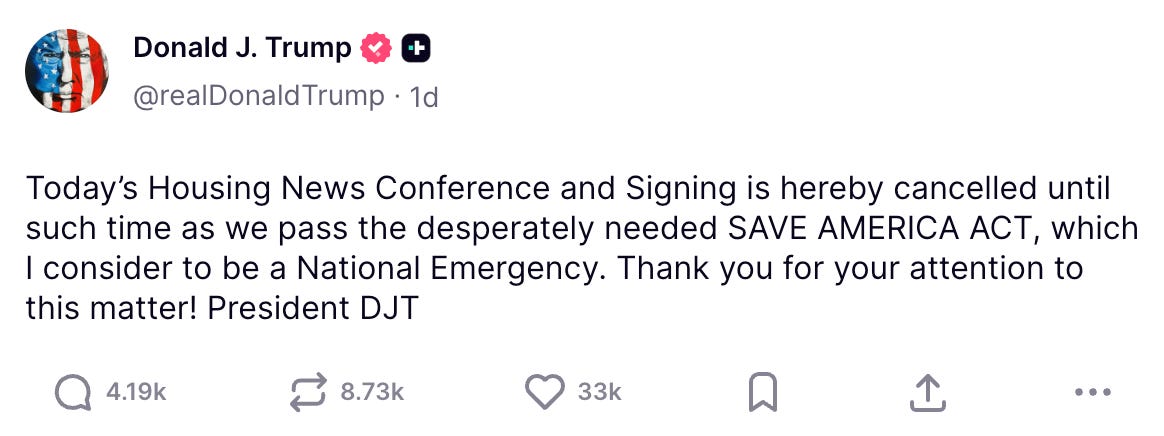
The conservative movement’s virtual singular focus right now on election administration is exceedingly concerning. We’ve not only seen gerrymandering in states to protect Republican seats and counter-gerrymandering in Democratic seats, but some conservatives also want to use nefarious means to keep control of the House and election administration proposals to restrict state election laws. And, on Thursday, Trump wrote on his social media platform that the SAVE American Act is “a national emergency,” which recalls what conservative attorney Cleta Mitchell said in September 2025; that Trump may “exercise some emergency powers to protect the federal elections going forward.” The stage is clearly being set for more interference.
Is there any good news? Yes. First, DOJ hasn’t won a single lawsuit against a state over its demands for access to voter rolls. Second, U.S. District Judge Indira Talwani shot down Trump’s March 2026 executive order and the USPS rule. In her order, Talwani explained, “[N]o law enacted by Congress delegates authority to control mail-in voting to USPS. The voting-related guidance currently issued by USPS is not binding on the States, merely recommended.”
Don’t mistake this loss for the administration as the end of the story. The administration has shown a stubborn willingness to push the limits of executive power whenever Congress refuses to give it what it wants. This USPS rule is only the latest example. There will almost certainly be another. The question isn’t whether the next attempt is coming. It’s whether the courts are resilient enough to continue to serve as a check before the rules of the game are changed in the middle of the game itself.
Most of the states that have turned over the information are traditionally Republican. However, some states—Alaska, Florida, Iowa, Ohio, and Texas—have competitive House and Senate races that could decide control of the chambers.
Those states are Arizona, California, Maine, Maryland, Massachusetts, Michigan, Oregon, Rhode Island, and Wisconsin.
Three-fifths were required for passage. Sens. Susan Collins (R-ME), Mitch McConnell (R-KY), Lisa Murkowski (R-AK), and Thom Tillis (R-NC) voted against the amendment. A separate amendment offered during vote-a-rama by Sen. Mike Lee (R-UT), which doesn’t include the language to eliminate mail-in voting, got 50 votes. McConnell, Murkowski, and Tillis voted against that amendment, which, again, required three-fifths for adoption.