

The Securing Agriculture’s Workforce Act Modernizes the H-2A Visa Program
Screaming "amnesty" isn't going to make the worker shortage go away

Immigration restrictionists are losing their collective minds over recently introduced legislation that would overhaul the H-2A visa program. Their loudest criticism centers on one provision involving undocumented agricultural workers already in the United States. We’ll come back to that provision shortly because understanding the rest of the bill provides important context.
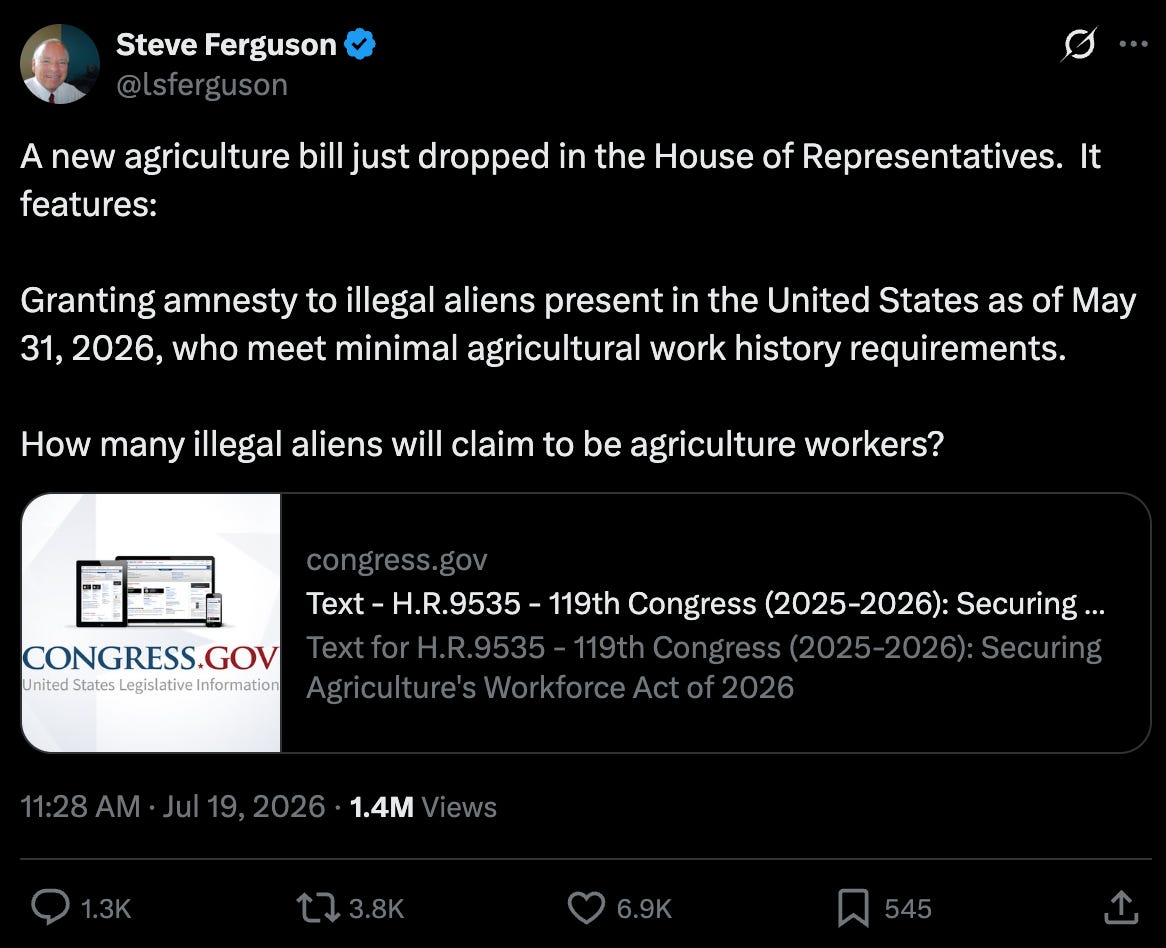
The bill in question is the Securing Agriculture’s Workforce Act, H.R. 9535. It was introduced on June 30 by House Agriculture Committee Chairman Glenn Thompson, and it boasts a bipartisan group of 51 original sponsors. You may think that the cosponsors are mostly moderates, but that’s not the case. Although the bill has bipartisan support, the cosponsors are overwhelmingly Republican and include Reps. Brian Jack (R-GA), Lloyd Smucker (R-PA), Austin Scott (R-GA), and Brett Guthrie (R-KY).
Created by the Immigration Reform and Control Act of 1986, the H-2A visa program allows agricultural employers to hire foreign nationals to perform temporary or seasonal farm work when there are not enough “able, willing, and qualified” workers available.1 Employers must obtain certification from the Department of Labor demonstrating a labor shortage and showing that employing foreign workers won’t adversely affect the wages or working conditions of similarly employed workers before hiring H-2A workers.
Before diving into the details of the Securing Agriculture’s Workforce Act, it’s worth understanding what the bill is trying to accomplish. Many producers have argued that the H-2A visa program has become too rigid, too expensive, and too cumbersome to meet the needs of modern agriculture. The Securing Agriculture’s Workforce Act attempts to address those concerns without fundamentally changing the program’s core premise. Instead, it proposes a series of reforms intended to expand access to H-2A, modernize its administration, and provide greater certainty for both employers and workers.
The most significant change that the Securing Agriculture’s Workforce Act would make is that it would expand the H-2A program beyond seasonal agriculture. Under current law, employers generally must demonstrate a temporary or seasonal need for labor, which largely excludes year-round operations such as dairy farms, livestock producers, and poultry operations. The legislation would allow many of those employers to participate in H-2A for the first time, making the program available to a much broader segment of the agricultural economy.
The legislation also attempts to modernize the application process. Agricultural employers have long complained that obtaining H-2A workers requires navigating duplicative paperwork and lengthy processing times involving multiple federal agencies. The bill would streamline those procedures through a more centralized, electronic application process while preserving the statutory requirement that employers first demonstrate a shortage of available U.S. workers.
Another major area of reform involves wages. Current regulations rely heavily on the Adverse Effect Wage Rate (AEWR), which many producers argue has increased rapidly and created year-to-year uncertainty. The bill would revise how required wages are calculated to make labor costs more predictable while maintaining wage protections for domestic workers.
Because year-round agricultural operations have different workforce needs than seasonal farms, the legislation also establishes a framework governing the admission of year-round H-2A workers. That includes numerical limitations and other rules intended to manage the program’s expansion while recognizing that some agricultural sectors require a stable workforce throughout the year.
The bill would also make it easier for H-2A workers to move between participating employers under certain circumstances. Under the current system, workers are generally tied to the employer that petitioned for them, which can create problems for both workers and producers when employment ends unexpectedly. Allowing greater portability could help employers fill vacancies more quickly while reducing disruptions for workers already lawfully present in the United States.
The legislation contains numerous administrative reforms affecting housing and transportation requirements, employer associations, labor contractors, filing deadlines, recruitment procedures, electronic processing, and other aspects of the H-2A program. Individually, many of these changes are technical. Collectively, they reflect an effort to make a program created nearly four decades ago better suited to the realities of today’s agricultural workforce.
The Securing Agriculture’s Workforce Act also includes one provision that has generated the most controversy. Certain undocumented agricultural workers already in the United States would be eligible to apply for H-2A status if they satisfy the legislation’s work-history requirements. Specifically, the bill would waive specified immigration grounds related to unlawful presence, unauthorized employment, and certain immigration status violations for workers who were unlawfully present in the United States on May 31, 2026, and who can demonstrate a sufficient history of agricultural employment. Employers would also be permitted to continue employing those workers while their applications are pending.
Some immigration restrictionists immediately labeled the proposal “amnesty.” I think that overstates what the bill actually does. The question is whether providing temporary H-2A status to experienced agricultural workers who meet strict eligibility requirements is fairly described as “amnesty.” Critics use that label because the bill would forgive certain prior immigration violations for a defined class of existing agricultural workers so they can obtain H-2A status.2 Whether that constitutes “amnesty” depends largely on how broadly one defines the term.
Historically, the term “amnesty” has most often been associated with broad legalization programs that forgive unlawful presence and place recipients on a path toward permanent legal status or citizenship. That’s what Congress enacted in 1986, and it’s what proposals like the Farm Workforce Modernization Act contemplated through a certified agricultural worker program. The Securing Agriculture’s Workforce Act does something considerably narrower. It allows a limited class of existing agricultural workers to obtain temporary H-2A status, but it does not create a pathway to lawful permanent residence or citizenship. The workers remain in a temporary, employer-sponsored visa program.
Reasonable people can disagree over whether Congress should adopt that policy.3 That’s a legitimate debate. That said, the debate isn’t about a sweeping legalization program. That’s simply not what this bill does, and it’s disingenuous to say otherwise.
The broader reality is that the United States is confronting a labor shortage that extends well beyond agriculture. As I‘ve written before, annual deaths are projected to outnumber births beginning around 2031, and the population is expected to begin declining in the decades that follow unless immigration offsets those losses. You can’t sustain long-term economic growth, fund entitlement programs, or compete with countries like China while simultaneously insisting that virtually no one should be allowed to come here to work. An economy needs workers. Hanging a “We’re Closed” sign on the country may be politically satisfying to some, but it doesn’t solve the demographic math.
The quoted language comes directly from 8 U.S.C. §1188(a)(1).
There are other reasons to use the term “amnesty.” If you want to rile up immigration restrictionists in the conservative movement, that’s how to do it.
Granted, I’ve yet to see a compelling reason why Congress shouldn’t pass legislation that does something along the lines of what the Securing Agriculture’s Workforce Act would accomplish, but I want more immigration, not less.