

The Discharge Petition Process Is a Way to Break the Legislative Logjam
Some House Republicans are upset with their colleagues for signing discharge petitions

A couple of years ago, I wrote a post noting that we could see an uptick in the number of discharge petitions to secure votes on legislation that House Republican leadership wouldn’t otherwise bring to the floor. I was more explaining the process than going into the reasons why discharge petitions would be used more frequently.
A discharge motion is a process provided by the Rules of the House of Representatives in Rule XV, clause 2.1 The process can be a little complicated. The gist is that a bill that has been referred to committee for a minimum of 30 legislative days can be discharged if 218 members sign a petition filed with the Clerk of the House.2 A special rule may be discharged after seven legislative days if the underlying bill has been in committee for at least 30 days.
Prior to the 118th Congress, discharge petitions were rarely successful. From 2001 through 2022, only two discharge petitions made their way through the process. In 2002, the discharge petition for the Bipartisan Campaign Reform Act, H.R. 2356, was successfully discharged, and the bill became law. In 2015, the discharge petition for the Export-Import Bank Reform and Reauthorization Act, H.R. 597, got the needed 218 signatures and passed the House.3 Large majorities were more than the rule than the exception at the time. From 2001 through 2020, the smallest majority was 221. The average majority was 237 members. Finding enough members to sign a discharge petition was a challenge.
By the end of the 118th Congress (2023-2024), two discharge petitions got the requisite 218 signatures to move forward. Those were discharge petitions No. 11 and No. 16. In both instances, House Republican leadership allowed votes on the underlying legislation rather than advancing the discharge petition process. No. 11 discharged a rule, H.Res. 961, to provide for the consideration of the Federal Disaster Tax Relief Act, H.R. 5863. No. 16 also discharged a rule, H.Res. 1410, to provide for the consideration of the Social Security Fairness Act, H.R. 82. Both bills passed and became law.
That brings us to the 119th Congress. Discharge petitions have seen a lot of use in the current Congress because of the logjam created by House Republican leadership, led by Speaker Mike Johnson (R-LA). Discharge petitions have been leaned on more to move legislation than in the past. Seven discharge petitions—No. 1, No. 6, No. 8, No. 9, No. 10, No. 15, and No. 19—have gotten the needed 218 signatures. Four have moved forward through the process.
No. 6: Discharged H.Res. 432 to provide for the consideration of the Protect America’s Workforce Act, H.R. 2550.
No. 8: Discharged H.Res. 518 to provide for the consideration of the Ukraine Support Act, H.R. 2913.
No. 10: Discharged H.Res. 780 to provide for the consideration of the Breaking the Gridlock Act, H.R. 1834.
No. 15: Discharged H.Res. 965 to provide for the consideration of a bill to require the Secretary of Homeland Security to designate Haiti for temporary protected status, H.R. 1689.
Two discharge petitions received the 218 signatures needed to move forward, but didn’t. Those were No. 1 (parental proxy voting4) and No. 9 (Epstein Files Transparency Act5). Discharge petition No. 4 didn’t get the needed signatures. Rather, it was brought to the floor under the process provided by the National Emergencies Act, found at 50 U.S.C. § 1622.6 There’s also one discharge petition, No. 19, that has received the 218 signatures needed to be discharged. It hasn’t moved forward yet.
So, why are we seeing this increased reliance on discharge petitions? With a slim majority, 25 Republicans in competitive or potentially competitive districts, and a House that isn’t really legislating on tough issues, vulnerable members are looking for ways to break through the gridlock. The discharge petition process provides a way to break through the logjam that House Republican leadership has created to get votes on tough issues.
The best ways for a vulnerable member to distance themselves from Trump or House Republican leadership are to use their voting card or to introduce legislation or an amendment to address an issue. Each of these presents challenges that aren’t always easy to avoid. Voting against the White House’s position could mean an angry post on social media from Trump, a primary challenge, irate constituents, or even threats of harm. The amendment process is so carefully controlled, or so often shut down, that it may not be a viable option. Merely introducing legislation doesn’t mean much. If the White House and/or leadership oppose your bill, you won’t get a markup.
In other words, members who may need the legislative process to distinguish themselves in their reelection campaigns may become victims of the dysfunction. If you look at the Republicans who have signed the most discharge petitions, they tend to be from competitive districts. For example, Reps. Brian Fitzpatrick (R-PA) and Mike Lawler (R-NY) have both signed eight discharge petitions in the 119th Congress. Reps. Don Bacon (R-NE) and Rob Bresnahan (R-PA) have signed six. Lawler and Bresnahan are in toss-up districts. Fitzpatrick’s district leans Republican. Bacon isn’t seeking reelection, but his district is likely to flip in November.
None of this is to say that those vulnerable Republicans who sign discharge petitions are free from criticism or may not be punished in some way. The argument we often hear about discharge petitions is that they take power from the majority and give it to the minority. Folks, this process has existed in some form or fashion since 1910.7 It exists precisely to break through a legislative logjam caused by a Speaker or leadership. It’s a necessary legislative process.
Fitzpatrick plans to introduce a discharge petition to prohibit the Department of Justice’s so-called “anti-weaponization” slush fund, and House Rules Chairwoman Virginia Foxx (R-NC) isn’t happy about it. Apparently, some share the sentiment. She wants to get back contributions from House Republicans who are on the National Republican Congressional Committee’s (NRCC) Patriots list.
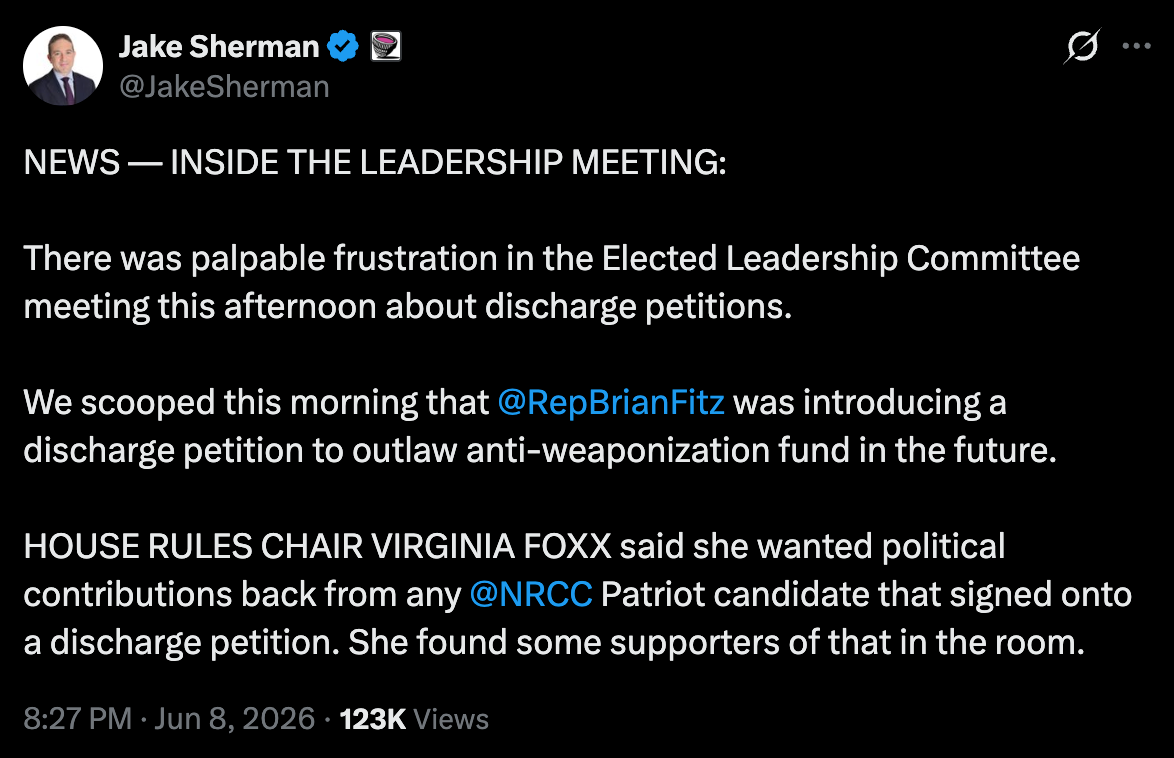
Being an NRCC “Patriot” basically means you’re in a very competitive race.8 It signals to donors that they should send money to your campaign. Who’s on that list? Several members who have signed discharge petitions. Fitzpatrick, Lawler, and Bresnahan are on the list. As are Reps. Jen Kiggans (R-VA), Zach Nunn (R-IA), and David Valadao (R-CA), each of whom has signed a discharge petition in the 119th Congress.9
It’s incredibly shortsighted to ask these members to return contributions they’ve received because you’re essentially signaling that you don’t want them in the House.10 I’m not making a case for or against these members. I’m just looking at the politics of this. It’s the difference between Foxx being the chair of the Rules Committee or the ranking member. Republicans don’t have a majority in the House without these members, and there’s no chance of a majority in January 2027 without them.
See p. 29-30 at the link.
The required number is not a simple majority of the House. It’s 218 signatures, regardless of how many members are seated.
The Export-Import Bank Reform and Reauthorization Act did not become law. Ex-Im reauthorization was put into the 2015 highway bill—the FAST Act, H.R. 22. That’s how Ex-Im was reauthorized.
Rep. Anna Paulina Luna (R-FL) led this discharge petition. She got the 218 signatures but abandoned the effort after reaching a deal with Speaker Mike Johnson (R-LA). The House later tabled the rule subject to the discharge motion.
For whatever reason, House Republican leadership brought the Epstein Files Transparency Act to the floor on suspension as H.R. 4405. This specific bill wasn’t covered by the discharge petition. (The rule covered by discharge petition No. 9 would’ve amended a shell bill, H.R. 185, with the text of the Epstein Files Transparency Act.) What I’ve heard is that House Republican leadership didn’t want to give Rep. Thomas Massie (R-KY), who led the discharge petition, a legislative win.
House Republican leadership eventually stopped joint resolutions from coming to the floor under the process in the National Emergencies Act (NEA) in Section 4 of H.Res. 211 through the First Session of the 119th Congress. H.Res. 707 amended H.Res. 211 to expire on March 31, 2026. H.Res. 707 was amended by H.Res. 1131 to prevent joint resolutions under NEA from coming to the floor for the remainder of the 119th Congress.
This report on the discharge petition process is out of date, but it has the history. The most up-to-date report on the discharge petition process is here.
It looks like the members on the list all represent toss-up districts.
Kiggans and Valadao have signed two each (No. 13 and No. 14). Nunn has signed one (No. 11).
Ironically, these members could also use Foxx’s comments to show that they’re willing to go against their party. It could help them with voters, even if it hurts their standing with the House Republican Conference.